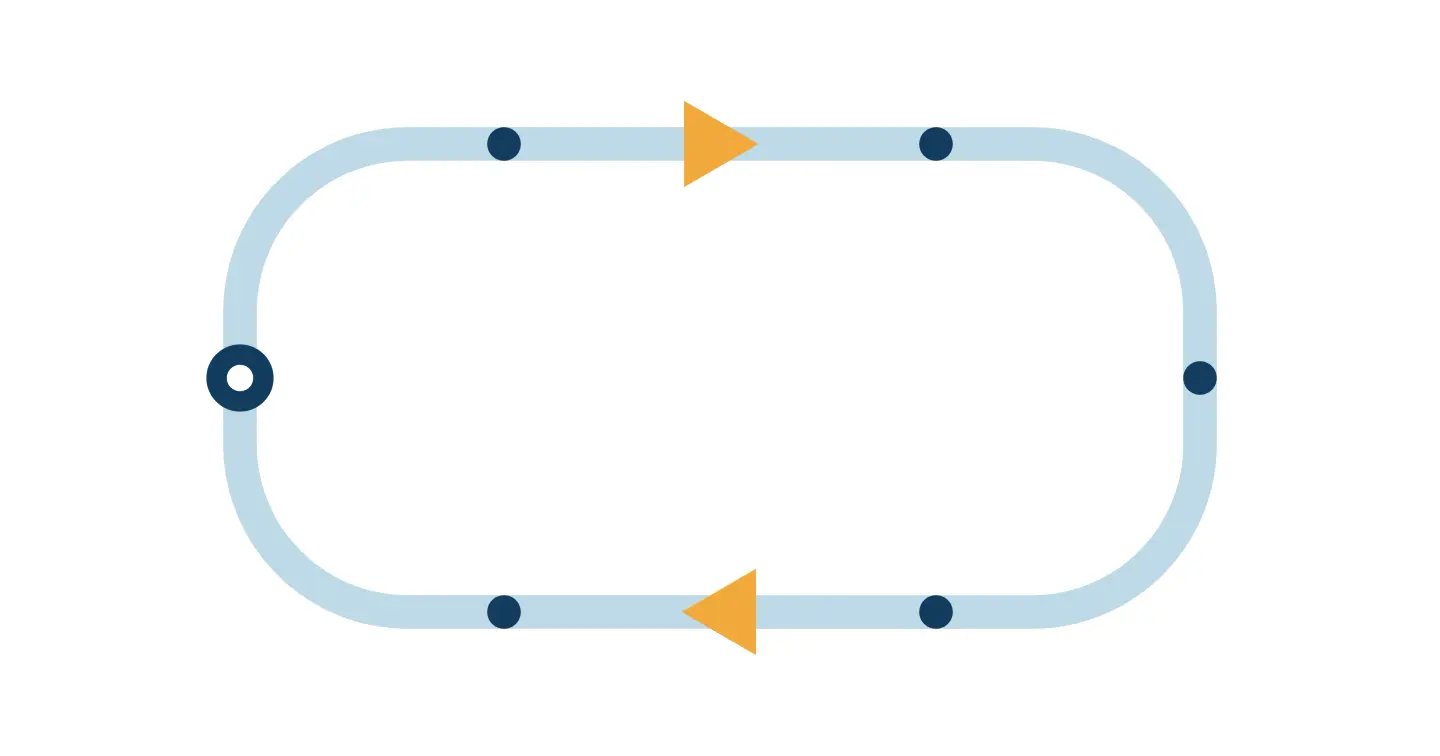
Most lines work in a way that's easy to picture: they set off from one end, reach the other, turn around and come back the same way. A loop route has no other end. It traces a closed circuit and returns to where it started, without turning around anywhere along the way.
That's what makes it useful — and what makes it confusing.
What a loop route looks like
A loop route's path is closed. The vehicle passes through a series of stops, arrives back at the first one, and carries on into another circuit.
This means the line doesn't really have an "out" and a "back". It has a direction of travel around the loop.
Usually there are two directions — one clockwise, one anticlockwise. Both pass through the same stops, but in reverse order.
Why cities introduce loop routes
A loop route solves a problem radial lines handle poorly.
Most of a network points towards the centre. If you want to get from one outlying neighbourhood to the one next to it, you often have to go into the centre and back out, even though the two are close together.
A loop route connects the city's outer ring directly, without passing through the centre. It shortens those trips and takes pressure off central interchanges.
The other common case is serving one large neighbourhood: the line makes a circuit through it and rejoins the main corridor, instead of turning around somewhere inside.
The main trap: two directions on one path
This is where passengers most often go wrong.
At a loop route's stop, both directions frequently use the same location or the one across the street. If you board the wrong direction you won't notice straight away — the vehicle travels the streets you expected, just in reverse order.
The result is that a destination a few stops away is reached only after almost a full circuit.
How to identify the direction
The number is no help here, since it's the same both ways. Three things are.
First, the direction shown on the sign. On loop routes this usually isn't a terminus but the name of a characteristic stop on that part of the circuit.
Second, the order of stops. Look at which one comes after the stop you're standing at; if the name feels like it's in the wrong direction, it probably is.
Third, where the vehicle stops. If the two directions use opposite sides of the street, the side tells you everything. Which stop serves which direction is shown on the stops list.
The loop at the end of an ordinary line
There's also an in-between form that passengers often mistake for a true loop route.
Many ordinary lines don't turn at a turning circle at the end of the route; instead they make a small one-way loop through a neighbourhood and rejoin the same corridor. Formally this is still an ordinary line with two ends, but the last few stops are served in one direction only.
For passengers that means two things. The stop where you get off on arrival usually isn't the one you board at for the return. And running time differs by direction, because the loop is covered only once per circuit.
If a line seems to take longer one way than the other, a loop at the end of the route is a common reason.
Why loop routes fall behind more easily
On an ordinary line, the terminus is where everything resets: the vehicle arrives, waits for its scheduled time and departs punctually into the next run. That's built-in protection against delay carrying forward.
A loop route has no true terminus. Unless a point on the circuit is designated where the vehicle is held and brought back into rhythm, a morning delay is passed from circuit to circuit all day long.
That's why well-planned loop routes always have a designated place on the loop that plays the role of a terminus, even when there's no turning circle there.
When a loop makes sense and when it doesn't
A loop route works well when journeys run in several different directions around the outer ring and there's no single dominant destination.
When most passengers are heading to the same place, an ordinary line is better: it's shorter, easier to understand, and doesn't risk sending half its passengers the long way round.
That's why in most networks loop routes aren't the backbone but a supplement — covering connections that would otherwise require a change.
You can check any line's route and directions on its own page, for example line 2A.
Frequently asked questions
Does a loop route have a final stop? Formally there's usually one point recorded as both first and last, but passengers don't experience it as a terminus, because the vehicle doesn't turn around there.
Is my ticket still valid if I accidentally go the wrong way? It depends on the rules in your city and the type of ticket — time-based and single tickets differ. What applies to which type is on the tickets page.
Why do some loop routes run in one direction only? Because of one-way streets or insufficient demand. In that case returning the same way isn't possible, so you either ride out the rest of the circuit or change.