If you've lived in a city long enough, you know the numbers of the lines you use by heart. But the moment you need a line you don't normally ride, the questions start: why is there a letter next to the number, why do two numbers one apart head in completely different directions, and what do the markings that only appear at night mean?
Here's what line markings really tell you, and what they don't.
The number is a name, not a ranking
The most common misunderstanding is expecting numbers to rank something — that line 5 is somehow "closer to the centre" than line 50, or that neighbouring numbers are neighbours on the map too.
A line number is first and foremost an identifier. Its most important quality isn't logic but permanence. Once it takes hold, people remember it; it's printed on signs, embedded in habits and in everyday conversation. Changing it without real need means confusing everyone who has used that line for years.
That's why in most cities numbers aren't ordered by geography but by history — by the sequence in which lines came into being.
Why neighbouring numbers don't head the same way
A network isn't built all at once. Lines are added, withdrawn, merged and split over decades. A number that once made sense relative to its neighbours stays put even after everything around it has changed.
You'll usually still find partial logic in groupings. Cities typically reserve number ranges for particular modes or parts of the network — one range for trams, another for trolleybuses, a third for suburban services. When a new line is introduced it takes a free number from the appropriate range, so the grouping stays recognisable over time.
That logic is still almost always incomplete. There are exceptions, lines that changed vehicle type but kept their old number, and leftovers from earlier arrangements. So it isn't worth relying on when planning a trip — treat it as rough orientation, not a rule.
A letter beside the number: a variant of the same line
When you see a letter next to a number, it almost always means there's a base line and a variant of it.
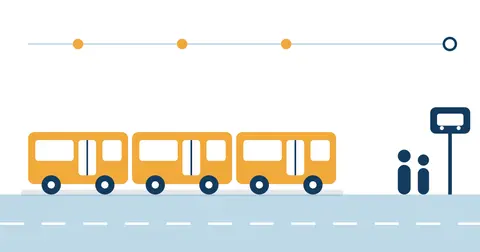
The variant shares most of its route with the base line but branches off somewhere — running to a different terminus, looping through one neighbourhood, or skipping a section.
Short and extended variants
There are two typical cases.
A short variant covers only part of the base route. It's introduced when demand on one section is far heavier than on the rest, so there's no point sending every vehicle all the way.
An extended variant runs beyond the base terminus, usually to a neighbourhood that doesn't have enough passengers for a line of its own but has enough for a few departures a day.
The same applies to markings with a slash or an extra digit — these usually distinguish departures by route, not by mode of transport.
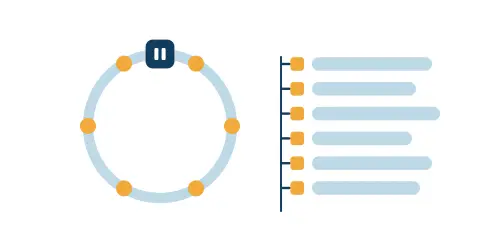
Which variant serves which location is easiest to check on the stops list, since that's exactly where variants differ.
Night and special markings
The night network is generally separate from the daytime one. It has fewer lines, longer routes and different interchanges, because at night the same number of people don't travel in the same directions.
That's why night lines almost always carry a distinct marking — a prefix, a suffix, or their own number range — so they're immediately distinguishable from daytime services. The point is that a passenger should know at a glance they're looking at a different network, even when a night line partly follows the route of a daytime one with a similar number.
Much the same goes for lines set apart by vehicle type or by zone. If a line leaves the city zone, the marking often doubles as a reminder that a different fare applies. What that means for the cost of your trip is on the tickets page.
Why withdrawn numbers aren't reassigned right away
When a line stops running, its number usually sits unused for a long time.
The reason is practical. The number still lives in people's heads, on old signs, in notices and instructions. Assign it immediately to a completely different route and a passenger who remembers it will board the wrong vehicle — a worse mistake than leaving a number idle for a while.
What you should actually be reading on the sign
The number tells you which line it is, but not where the vehicle is heading right now. That's what the terminus name on the front sign is for.
This matters most on loop routes and on lines with variants, where the same number can set off in two different directions. Always read the number and the terminus together, never the number alone.
You can check an individual line's route and directions on its own page, for example line 77.
Frequently asked questions
Does a letter next to the number mean a faster line? No. The letter marks a route variant, not speed or rank. A variant can even be slower than the base line if it takes a detour.
Why does the same line sometimes have different termini during the day? Because short workings run at certain times of day. The base route stays the same, but some vehicles turn back early.
Can I guess the direction from the number? You shouldn't. Numbering is largely historical, so neighbouring numbers can lead to completely opposite sides of the city.