When a bus lane appears on a street, it's usually presented as a measure that will speed up transit. That's true, but it's half the story — and the less important half.
A bus lane's greatest benefit isn't speed. It's predictability.
Speed is visible, predictability is useful
If a vehicle gains a few minutes on average along a stretch, that's nice, but it's easily lost at the next junction.
Far more important is that the time taken to cross that stretch stops varying. In mixed traffic the same kilometre can take four minutes or twelve, depending on the day. In a dedicated lane, that range narrows.
This changes something passengers don't see directly: how much slack has to be built into the timetable.
Why this matters for the whole day, not one trip
In our piece on timetables we covered how the number of vehicles comes from round-trip time divided by headway. Round-trip time includes the slack left in case of delay.
If the time to cross a corridor stabilises, that slack can be smaller. A shorter round trip means the same headway can be held with fewer vehicles — or that the same fleet delivers more frequent departures.
That's why a well-executed bus lane doesn't just improve one trip. It changes the arithmetic of the entire line.
Signal priority: two approaches
Signal priority means the signal plan works in favour of transit vehicles. There are two ways to do it.
Passive priority
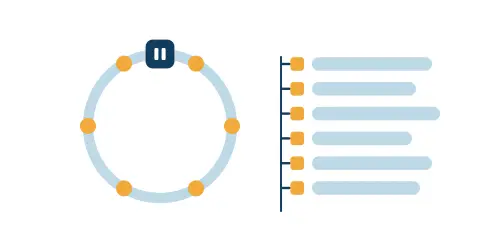
The passive approach doesn't know where vehicles are. The signal plan is set in advance to suit the rhythm of transit on that corridor — a green wave matched to the speed a bus actually travels at, including time spent at stops.
Active priority
The active approach does know where vehicles are. As a vehicle approaches a junction, the system detects it and responds: extending a green that's already running, or cutting a red short.
Active priority is more powerful but demands equipment, maintenance and careful tuning. Grant priority too often and the rest of the junction is disrupted, so the gain is lost on the other side.
Why lanes often don't work
This is the part least often discussed. A lane painted on asphalt isn't a measure; the measure is a lane used as intended.
The most common reasons a lane delivers nothing:
Parking and stopping in the lane. One delivery vehicle turns the lane into an obstacle, because the bus has to pull out into the next one and back again.
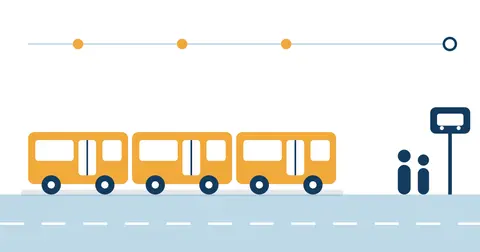
Discontinuous sections. A lane that runs for three junctions, stops, then resumes loses most of its effect. The vehicle keeps rejoining the queue.
A lane without priority at the junction. If a vehicle runs freely up to the signal and then waits like everyone else, the gain is eaten at the back of the queue.
A lane in the wrong place. It's worth most where congestion is worst — usually the approach to a junction, not the middle of a block.
No enforcement. Without compliance checks, a lane becomes a suggestion.
What a lane doesn't fix
A dedicated lane solves one part of the problem — time spent in a queue. It doesn't touch the rest.
It doesn't shorten dwell time at stops. If boarding is through one door and fares are paid to the driver, the vehicle will stand just as long in a perfect lane.
It doesn't change headway. A corridor can be fast while the line along it runs every twenty minutes; for passengers the wait is then a bigger problem than the ride.
It doesn't correct a poor route. If a line goes the long way round, travelling that long way faster is still the long way round.
That's why a lane pays off most when it's done alongside faster boarding and more frequent departures, not instead of them.
Why the effect only shows on long corridors
A short lane fixes a local bottleneck. Useful, but limited.
The measurable effect appears when lane and priority are delivered along an entire corridor, unbroken, with properly designed stops and junctions that participate. Then travel time becomes reliable over the whole length, not just one section.
That's why cities serious about this rarely work lane by lane; they pick one corridor and finish it.
Which lines run along which corridor is shown on the stops list, and the basic terms are explained in our guide.
Frequently asked questions
Does a bus lane slow down other traffic? In the short term along that stretch it usually does, since lanes available to other vehicles are reduced. The wider effect depends on how many people switch to transit once it's faster, and that varies from corridor to corridor.
Why does a bus wait at a signal if priority exists? Priority isn't unconditional. Systems generally don't intervene if doing so would disrupt the junction too much, if the vehicle is exactly on schedule, or if priority was granted recently.
Do lanes apply at night too? It depends on each city's rules. Some lanes only operate during set hours, because outside the peak there's no congestion to justify them.