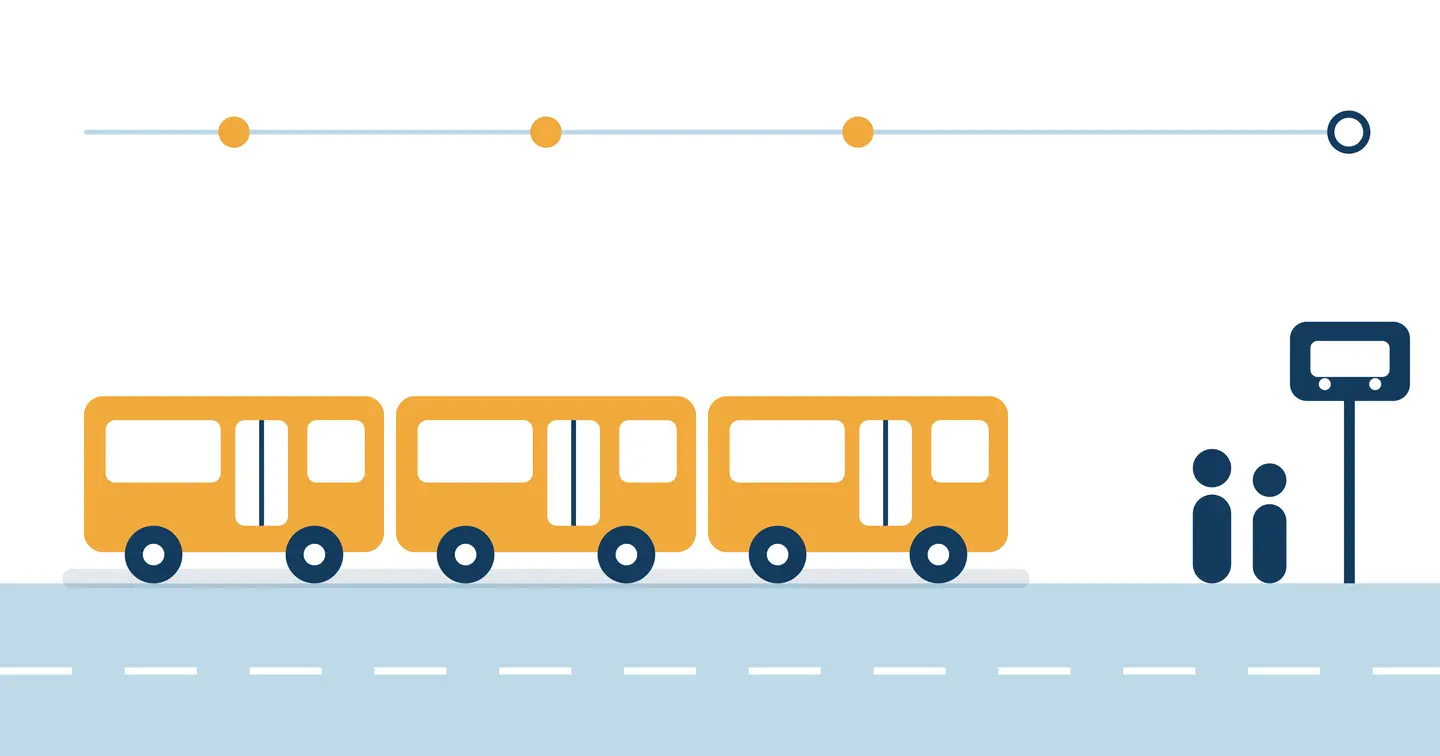
If you use city transit often, you know the feeling. You wait longer than the timetable says, you start wondering whether you missed something — and then two or three vehicles from the same line show up one behind the other. The first is packed, the last is half empty.
This usually isn't the driver's mistake or a dispatcher's oversight. It's a phenomenon transit planners call bus bunching, and it happens in every city in the world with frequent service, from Belgrade to London.
How the convoy forms
Picture a line where vehicles depart at even intervals, say every ten minutes. Everything works until the first small delay: a longer stop, a blocked lane, an unusually long traffic light cycle, a passenger looking for change.
The first vehicle is now one minute late. Because of that minute, slightly more people are waiting at the next stop — simply because they had one extra minute to arrive. More passengers means slower boarding, so the delay grows to two minutes.
At the stop after that, even more people are waiting. The delay grows to three, four, five minutes. Every stop makes things worse instead of better.
Why the vehicle behind speeds up
Meanwhile, the next vehicle on the line has the opposite problem. It reaches stops the previous vehicle has just cleared. It finds few people, loads them quickly and moves on.
Shorter stops mean it runs faster than its intended rhythm and slowly catches up to the one ahead. Once two vehicles end up back to back, they rarely separate on their own: the first keeps collecting everyone and falls further behind, the second runs nearly empty right on its tail.
That's why you see them together. And that's why the first vehicle in a convoy always looks overcrowded.
What makes it worse
Bunching happens everywhere, but some conditions accelerate it:
Short headways. The smaller the gap between departures, the easier it is for two vehicles to merge. On lines running every half hour, a convoy is practically impossible.
Peak hours. More passengers per stop means longer dwell times and greater sensitivity to any delay.
Slow boarding. Single-door boarding and paying the driver multiply across passengers — every second per person becomes a minute per stop.
Long routes through congested areas. The longer a line travels through the busy core, the more chances it has to accumulate delay.
Unpredictable obstacles. Stopped delivery vehicles, roadworks, a car parked in the stop itself.
What operators do about it
The problem isn't unsolvable, but the fixes cost money and require discipline.
Terminal regulation. The simplest measure: if a vehicle reaches the terminus early, it waits until its scheduled departure time. Every new run starts from a clean slate.
Holding en route. Using GPS, a dispatcher sees that two vehicles have merged and holds one at a stop to restore the gap. To passengers on board it feels pointless, but it helps the whole line.
Short-turning. A vehicle that has fallen far behind can skip part of the route and pick up the next departure from the other end, instead of running a full late trip.
Separation from other traffic. Bus lanes, signal priority and well-designed stops reduce the number of situations where delay appears in the first place.
Faster boarding. All-door boarding and pre-paid fares cut dwell time at stops. We cover payment methods and ticket types in more detail on the tickets page.
What you can do as a passenger
You can't break up a convoy, but you can use it to your advantage.
If two vehicles arrive, take the second one. It's almost always emptier and reaches your destination at nearly the same time.
Don't chase the first vehicle at rush hour. If it pulls away in front of you, there's a good chance another one is right behind it.
Watch the gap, not the clock. On frequent lines, the exact departure time matters less than how long there's been nothing at all. You can check timetables and live arrivals on the line's own page, for example line 26.
Choose your stop wisely. Stops closer to the start of a route keep a steadier rhythm than those mid-route, where delay has already piled up. A full list of stops and the lines serving them is on the stops page.
Frequently asked questions
Does bunching mean the line doesn't have enough vehicles?
Not necessarily. More vehicles shorten the headway, but that alone doesn't fix the snowball effect — sometimes it makes it worse, since closer vehicles catch up more easily.
Why does a driver sit at a stop after everyone has boarded?
Usually to regulate the gap. If the vehicle arrived early or too close to the one ahead, it waits to get back into its intended rhythm.
Can tracking apps predict bunching?
They can show it once it exists, since they display real vehicle positions. Predicting it in advance is much harder, because it depends on live traffic. We explain how to read these displays in our guide.