History
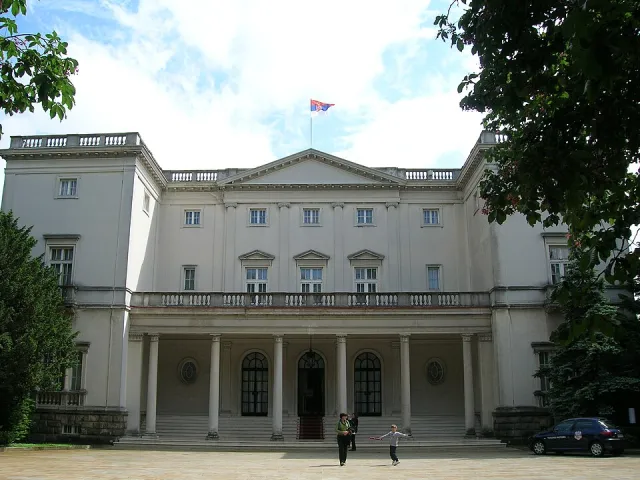
The White Palace was built on Dedinje hill between 1934 and 1936, at the wish of King Alexander I Karađorđević, who sought to provide a home for his sons, among them Crown Prince Peter II. The project was led by the architect Aleksandar Đorđević.
Since King Alexander was assassinated before the building was completed, construction was brought to a close by Prince Paul, who furnished the palace with valuable works of art and furniture, giving it the finished appearance it largely retains today.
After the Second World War, the White Palace was used for decades as a distinguished venue for receiving foreign officials, and in the late 1990s, during the presidency of Slobodan Milošević, it once again became an active setting for political talks — it was here, in 1999, that an important document relating to the end of the conflict with NATO was signed.
Architecture and significance
The interior of the White Palace exudes the luxury of various European styles: the dining room is furnished in the Chippendale style, while the large and small salons are decorated in the spirit of Louis XV. The walls display paintings by renowned masters such as Nicolas Poussin and Paolo Veronese, as well as works by the Serbian painter Paja Jovanović.
The building stands on the highest hill of Dedinje and occupies about 12 hectares within a much larger, 135-hectare complex of royal residences that also includes the Royal Palace, the kitchen, the garage, and the underground passages connecting them.
Good to know
The White Palace remains to this day the home of Crown Prince Alexander Karađorđević and his family, although officially it stays in the ownership of the Republic of Serbia.
Because it is still inhabited, the complex cannot be freely toured like a museum, yet its position on Dedinje still makes it one of the recognizable landmarks of this part of Belgrade.