History
The story of the church begins long before the first trowel of mortar was laid: according to tradition, in 1595 the Ottoman commander Sinan Pasha burned the relics of Saint Sava, the founder of the Serbian Orthodox Church, on Vračar hill. It was on that very spot, centuries later, that the decision was made to raise a church in his honour, and the foundations were laid on 10 May 1935.
Construction was anything but swift: wars, changes of government, and a shortage of funds stretched it out over decades. The project was designed by architects Bogdan Nestorović and Aleksandar Deroko, together with engineer Vojislav Zađina, and Branko Pešić later took over the direction of the works. The exterior of the church was finally completed in 2004, while the interior mosaics and decoration were carried on right up until 2020.
Architecture and significance
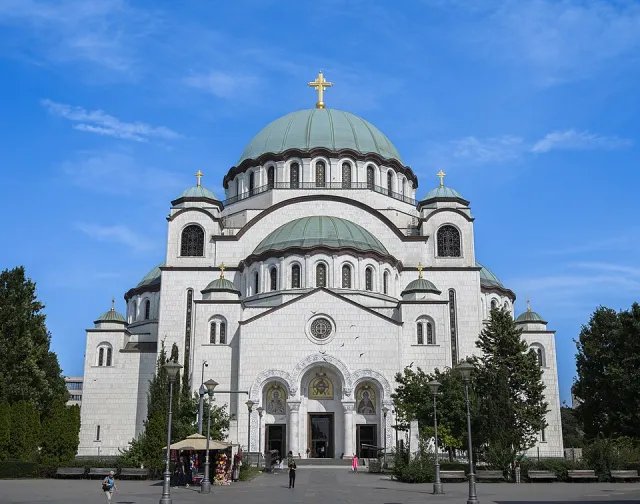
The church was conceived in the Serbo-Byzantine, or Neo-Byzantine, style, drawing clearly on the Hagia Sophia in Constantinople. It is of imposing scale: 91 metres long and 81 metres wide, with room for around 7,000 worshippers and a central dome more than 30 metres in diameter, ringed by twelve smaller domes.
Remarkably, that enormous main dome, weighing roughly 4,000 tonnes, was only set atop the church in 1989, and it was raised in just 40 days. Today the Church of Saint Sava is one of the largest Orthodox churches in the world, second in size only to the Cathedral of Christ the Saviour in Moscow, and an unmistakable symbol of the Belgrade skyline, visible from many points across the city.