History
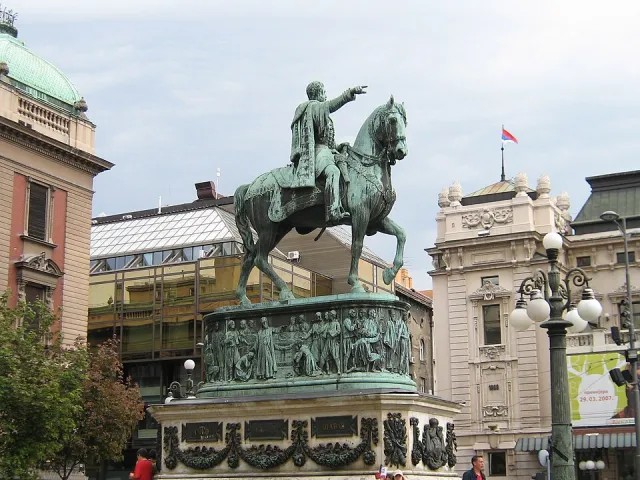
The Monument to Prince Mihailo was erected in 1882 on Republic Square, then known as Theatre Square, and it has been one of the most recognizable landmarks in central Belgrade ever since. The figure of the prince on horseback was cast in Munich in 1879 by the founder Ferdinand von Miller, while the sculpture itself was the work of the Italian sculptor Enrico Pazzi from Florence. The pedestal was designed by the architect Konstantin Jovanovic.
The horse was modelled on Vranac, a horse the prince received as a gift on his return from his wedding in Romania. Interestingly, the prince is depicted without a cap, an unusual choice for this type of monument at the time. For his work, Enrico Pazzi was decorated with the Order of the Knight of the Takovo Order, second class.
Art and Symbolism
This is the first monumental equestrian monument erected in Serbia, modelled on the classical Italian depictions of rulers on horseback rooted in ancient tradition. The monument consists of three parts - the base, the pedestal and the bronze figure of the prince - and his hand symbolically points towards the regions that had not yet been liberated at the time. The pedestal bears reliefs related to dynastic mythology, as well as plaques with the names of six cities liberated in 1867.
Because of its historical and artistic importance, the monument was declared a cultural monument of great importance. Over the years it has been restored several times - reconstructed in 1984, conserved in 1986, cleaned in 1995 and most recently restored in 2020, in order to preserve its appearance for future generations.