History
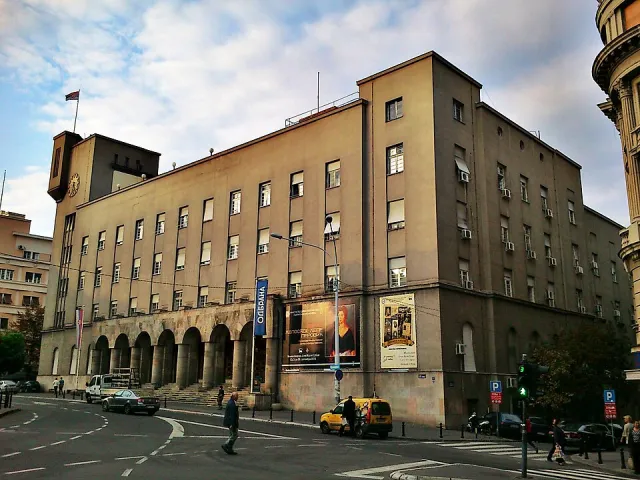
The building on Braće Jugovića Street was erected in the late 1920s and early 1930s as a hall intended for gatherings of soldiers and reserve officers. It was designed by architects Živojin Piperski and Jovan Jovanović, who, after winning the 1929 competition, were tasked with aligning their solution with the ideas of the second-place team, Bogdan Nestorović and Jovan Šnajder. The first part of the building was ceremonially opened on 29 May 1932, while the extension was completed and consecrated in 1939, or rather at the beginning of 1940.
In its first decades, the Warriors' Hall was a central venue for the cultural and social life of the military — it hosted associations of war veterans, the Sokol organisation, the Adriatic Guard and similar societies. The building's fate changed dramatically during the Second World War, when the German occupying administration used it for its own purposes, and from August 1941 it also housed the headquarters of the Gestapo for the Balkans. After the liberation, on 9 May 1946, the House of the Yugoslav People's Army was officially established in the building, its first commander being the academic painter Branko Šotra.
Architecture and significance
The palace was built in the spirit of modern architecture with touches of Expressionism, and its designers deliberately gave it a monumental, somewhat fortress-like appearance — an allusion to medieval strongholds meant to symbolise the military character of the building. This impression is especially emphasised by the corner tower facing Francuska Street, one of the more recognisable details of the façade. On account of its architectural and historical value, the building was declared a cultural monument in 1984 by decision of the Belgrade City Assembly.
Today the building houses the headquarters of the "Odbrana" (Defence) Media Centre and the "Stanislav Binički" Artistic Ensemble, which have used it since 2010. The space remains a living part of Belgrade's cultural map — it occasionally hosts exhibitions, concerts and conferences, so the building continues its original role as a gathering place, only in a new, civilian guise.